Riddles have a unique way of engaging our minds, making us think creatively and analytically. One such classic riddle that often stumps people involves a family with five daughters. If you’ve come across this riddle before, you’ve likely been caught off guard by its clever use of language. Let’s break it down and solve it step by step.
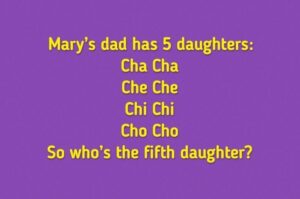
The riddle goes like this:
“Mary’s dad has five daughters, and their names are Cha, Che, Chi, and Cho. What’s the name of the fifth daughter?”
At first glance, it seems like the riddle is asking for a name that follows a pattern. However, the answer lies within the structure of the riddle itself. Let’s explore why.
Understanding the Structure of the Riddle
Before we dive into the solution, let’s first look at how riddles like this one are designed. The goal of many riddles is to distract the reader by presenting a sequence or pattern that leads them down the wrong path. In this case, the names “Cha,” “Che,” “Chi,” and “Cho” create an expectation for a fifth name that begins with “Chu.” However, this is a misdirection. The actual answer is hidden in the very first line of the riddle.
Identifying the Clue in the Riddle’s Setup
The key to solving this riddle is paying attention to the details. The riddle starts with, “Mary’s dad has five daughters.” This is the critical piece of information that often gets overlooked because our minds immediately jump to completing the pattern. But if you look closely, the riddle has already told you the name of the fifth daughter: Mary.
Why We Miss the Answer
The reason this riddle tricks so many people is simple. Our brains are wired to look for patterns, especially when it comes to sequences like “Cha,” “Che,” “Chi,” and “Cho.” When we hear a sequence of names that follow a phonetic pattern, we naturally expect the next name to fit that pattern as well. It’s a clever misdirection that keeps us from realizing that the answer is right in front of us. The first line literally tells us, “Mary’s dad has five daughters,” meaning Mary is one of them!
Breaking Down the Misdirection
Let’s dissect the misdirection a bit further:
Cha, Che, Chi, Cho: These names create a pattern that makes you believe the next name must follow a similar sound. This is where the trap lies. You’re conditioned to expect a name that begins with “Chu” or something similar, but that’s not the answer.
The Use of Mary’s Name: By stating “Mary’s dad,” the riddle subtly includes Mary as one of the daughters without making it too obvious. It’s a play on language that tricks you into focusing on the pattern rather than the logical conclusion.
The Importance of Paying Attention to Details
This riddle emphasizes the importance of careful reading and attention to detail. In many riddles, the answer is often simpler than we think, but our minds complicate things by overanalyzing or getting distracted by patterns. In this case, the solution is clear if you focus on the initial setup of the riddle: “Mary’s dad has five daughters.” This line tells you that Mary is the fifth daughter, so there’s no need to look for a name that fits the “Cha, Che, Chi, Cho” sequence.
The Final Answer: Mary Is the Fifth Daughter
Now that we’ve broken down the riddle and cleared up the confusion, it’s time for the final answer. The fifth daughter is Mary. The riddle cleverly disguises this fact by making you focus on a sequence of names, but the answer is actually provided in the very first sentence. Once you realize this, the riddle becomes simple and clear.
Conclusion: The Power of Simplicity in Riddles
The “Mary’s dad has five daughters” riddle is a great reminder that simplicity often holds the key to solving complex problems. By paying attention to the details and not letting ourselves get distracted by patterns or expectations, we can find the correct answers with ease.
Next time you come across a riddle like this, remember to take a step back and look at the bigger picture. Sometimes, the answer is hidden in plain sight, just waiting for you to notice it. In this case, the fifth daughter was always Mary, and the trick was in recognizing that the riddle had already given you the answer from the very beginning.
So, the next time someone asks you this riddle, you’ll be ready with the answer: The fifth daughter is Mary.