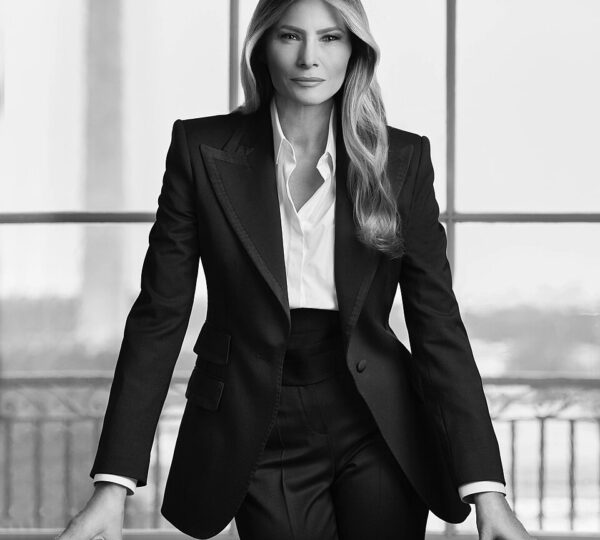
On January 27, 2025, the White House released the official portrait of First Lady Melania Trump, a striking black-and-white photograph taken days earlier inside the residence’s Yellow Oval Room.
The White House says the image was captured on January 21, 2025, by Belgian photographer Régine Mahaux, who also photographed Mrs. Trump’s 2017 portrait.
The portrait’s official release, posted with a short caption on the First Lady’s channels and on White House…
The White House says the image was captured on January 21, 2025, by Belgian photographer Régine Mahaux, who also photographed Mrs. Trump’s 2017 portrait.
The portrait’s official release, posted with a short caption on the First Lady’s channels and on White House platforms, marked a deliberate and carefully staged re-entry of Melania Trump into the public sphere following her husband’s inauguration for a second term.
Composition and wardrobe: a deliberate break from tradition.
Visually, the portrait departs sharply from the warmer, pastel-tinged official photographs typically associated with recent first ladies.
Rendered entirely in monochrome, the image places Melania at the center of a low-contrast, moody frame: she stands over a glossy, reflective desk, hands flat on the surface, a faraway, resolute expression on her face.
Through the window behind her, the Washington Monument is visible — faint, vertical, and symbolic — a background element that anchors the portrait in national iconography rather than personal intimacy.
Her clothing choices add to the portrait’s signaling.
Photographers and outlets reporting on the release noted that she wore a sharply tailored dark tuxedo jacket by an Italian house (reported in several outlets as Dolce & Gabbana for the jacket, paired with tailored trousers), and a clean white shirt—an aesthetic more commonly associated with corporate or editorial “power dressing” than with the soft-power, domestic cues of some earlier first-lady portraits.
The overall effect reads as intentional: a modern, executive silhouette that emphasizes control, poise, and a public role that leans toward authority rather than traditional consolation or maternal imagery.
The photographer’s intentions and the image’s production
Régine Mahaux, who has photographed Melania over many years, framed the portrait as a careful exercise in tone-setting rather than shock value.
In interviews and media notes accompanying the release, Mahaux described the portrait as a study in restraint — using a neutral palette, minimal retouching, and controlled lighting to create a refined, editorial look.
Mahaux emphasized that she aimed to capture aspects of personality she associated with the First Lady: composure, a sense of duty, and a private strength rather than overt sentiment.
Observers noted Mahaux’s long professional relationship with the Trumps and her familiarity with the First Lady’s visual preferences, which likely shaped the shoot’s economy of expression and careful staging.
Reactions: praise, puzzlement and sharp critiques
Reaction to the portrait was immediate and polarized.
Supporters and many on social media praised the image as “timeless,” “powerful,” and “elegant,” arguing that the portrait signals a First Lady who intends to stand as a sober, intentional public figure rather than a purely decorative or background presence.
Commentators sympathetic to this view said the portrait telegraphs seriousness and readiness to engage with policy-adjacent projects, humanitarian outreach, or crisis responses—roles that have become more visible in modern first-lady portfolios.
But critics were equally vocal. Some reviewers described the photograph as cold, overly stylized and emotionally distant—more a fashion editorial or corporate headshot than a warm, approachable presidential portrait.
A number of cultural commentators questioned whether heavy retouching and the monochrome aesthetic erased the humanizing details (lines, expressions) that make a portrait feel personal.
Vogue and other fashion outlets published particularly scathing takes, with at least one review using the phrase “freelance magician” to underscore how the look read as theatrical rather than authentic.
The breadth of responses made clear that the portrait functions as a Rorschach test: viewers interpret it through partisan, aesthetic and generational filters.
The inauguration hat and the wider visual strategy
The portrait’s release also arrived in the wake of extensive commentary about Melania’s inauguration-day wardrobe, when she appeared in a high-brimmed hat and a tailored coat that some critics called somber or even funeral-like.
The hat debate had already primed audiences to read visual cues in the new administration—what might have been intended as a refined, controlled aesthetic instead became fodder for intense scrutiny and social-media memes.
Fashion-world voices defended the choices as curated statements of taste and control, while other voices insisted the wardrobe choices amplified an aura of distance and inaccessibility.
Together, the inauguration look and the portrait form a consistent visual strategy: restraint, formality and an emphasis on image discipline.
Historical comparison: what changed from 2017?
Juxtaposed with her 2017 official photograph, the 2025 portrait is unmistakably different.
The earlier portrait was warmer in tone, softer in pose, and generally read as more conventionally “First Lady-like” in terms of emerging traditions of approachability and maternal symbolism.
The 2025 portrait looks outwardly harder: less about intimate connection and more about projecting gravitas, solidity and, some would argue, an iconography of authority.
For historians of presidential imagery, that shift echoes larger cultural debates about gender, power, and the visual languages leaders use to communicate with a polarized public.
Why the portrait matters: symbolism, messaging and the politics of appearance
Official portraits do more than show what a person looks like: they encode how an administration wishes to remember—and instruct the public to remember—its leading figures.
Melania Trump’s 2025 portrait seems to do precisely that: it directs attention to control, composure and a curated image of competence.
In doing so, it invites questions about accessibility and warmth, and about the role a modern first lady chooses to play.
Will this visual posture foreshadow more public policy involvement, a continued emphasis on fashion diplomacy, or simply a guarded private life at the center of public spectacle?
The answers will emerge not only from photographs but from action, travel schedules, causes she champions, and the soft power she wields in public life.
Final note
Whether one admires or dislikes the portrait, its release accomplished several communications goals:
it generated abundant media attention, crystallized a clear aesthetic, and reset public expectations for Melania Trump’s second tenure as First Lady.
If images are among the most durable artifacts of modern political life, then the 2025 portrait has already staked a claim:
that Melania Trump intends to be seen not as a background ornament but as a deliberate, stylized presence whose visual choices will themselves become part of the political conversation.